Monday, 21 December 2009

Another Evolutionary Nightmare: The Lungs of Birds

NEWS FLASH!


NEW! HOT OFF THE PRESS!!


“HOW DOES INSTINCT EVOLVE”

OR

Evolution's Soft Underbelly
by Asyncritus


AT LAST!

The Argument Darwin Dreaded…
The Argument No-One Has Developed Before…
The Argument to Which There Is

NO ANSWER FROM THE EVOLUTIONISTS!


35,000 viewers of my articles can’t all be wrong. Check Google for this subject and see!
http://www.thenakedscientists.com/forum/index.php?board=17.30

100 pages of amazing facts and carefully reasoned arguments. Equip yourself! Give your children the knowledge to defend belief in Creation in class!

Get your copy here. Only $19.97 as pdf.
$27 plus $5 p&p in CDR format.


CDR Version


Published by phillauren.org


BIRDS’ LUNGS

As Darwin said, “If it could be demonstrated that any complex organ existed which could not possibly have been formed by numerous, successive slight modifications, my theory would absolutely break down”

Here’s a prize example which pulverises it completely.

One of the very biggest stumbling blocks to the theory of evolution by gradual steps or in mighty leaps, is that group of magnificent creatures, the birds.

The theory at present, holds that the birds evolved from the reptiles. That the scales of reptiles somehow became frayed out and turned into feathers over millions and millions of years.

Look carefully at the scales on this snake.


Here’s a flight feather:
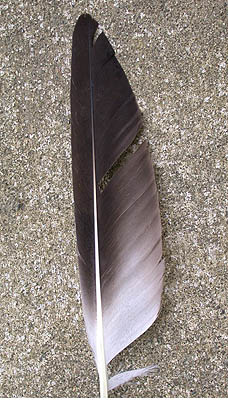


I’m sure you can see some of the visible problems involved in producing the flight feather from the scale. When we look at the detailed structure of the feather, the problems become astronomical, and the evolution proposal hopelessly absurd.

That somehow, a torpid, cold-blooded reptile turned into the warm-blooded bird with probably the highest metabolic rate in the animal kingdom. (In case the pedants are out in force, I am referring to the ectothermic and endothermic animals. Ectotherms have variable body temperatures, endotherms have constant body temperatures).

Whatever problems evolving that lot involved, they pale into insignificance in the presence of the one fact which I shall now describe. It is the difference between the lung of a reptile, and the lung of a bird.

To crudely illustrate the problems that the evolutionist has to account for, think of an ordinary balloon with air entering and leaving the balloon constantly full or partially deflated.

It enters the neck, goes into the balloon, and is squeezed out. BOTH INFLOW AND OUTFLOW USE THE SAME NECK. So air that is going to go out of the balloon, can mix with the air that’s just coming in. There is TWO WAY airflow.

That’s a reptile’s lung, very similar to ours. There’s a MIXTURE of incoming and outgoing air in our lungs.

Now think of one of those long, thin balloons, like the ones used at parties to make dogs and so forth, with a hole AT BOTH ENDS.

Bend it into a U shape, and blow into one end.

Air goes in at one end, and out the other, rather like a jet engine or a wind tunnel.

That’s how the bird’s lung works. IT USES ONE WAY TRAFFIC. There is NO MIXING of incoming and outgoing air.

How does the first sort of lung (in the reptile) become the second kind (in the bird)?

No evolutionary explanation for that fact is possible, and to hypothesise dinosaurs with feathers running round and turning into birds is a complete nonsense. Their lungs say so. As Michael Denton says:

“Just how such an utterly different respiratory system could have evolved gradually from the standard vertebrate design is fantastically difficult to envisage, especially bearing in mind that the maintenance of respiratory function is absolutely vital to the life of an organism to the extent that the slightest malfunction leads to death within minutes.”

So imagine a reptile whose lungs developed a big hole in the bottom for the air to flow through. Guess what? Yeah.

“Just as the feather cannot function as an organ of flight until the hooks and barbules are coadapted to fit together perfectly, so the avian lung cannot function as an organ of respiration until the parabronchi system which permeates it and the air sac system guarantees the parabronchi their air supply are both highly developed and able to function together in a perfectly integrated manner.”

Those are the headlines. Here is some more detail so any interested parties can examine them and satisfy themselves that the above description is correct. Follow the blue arrows in the exhalation diagram (the top one) and the inhalation diagram (below) to see that there is no mixing of incoming and outgoing air.

The advantageis that air, high in oxygen content, always moves unidirectionally through the lungs.”

Here is a more pictorial representation of exhalation. Just follow the blue arrows.


and inhalation:


The system is described as a counter-current/flow system, where air with the highest concentration of oxygen meets blood with the lowest concentration of oxygen across the membranes. It is an extremely efficient system, used by intelligent design engineers to maximize heat exchange or other. “In counter-flow heat exchangers the fluids enter the exchanger from opposite ends. The counter current design is most efficient, in that it can transfer the most heat.” Wiki.

Now you’ve looked at those facts, can you imagine how the one system could have evolved from the other?

Denker also raises the interesting point that “the avian lung cannot be inflated out of a collapsed state as happens in all other vertebrates after birth. … the air capillaries are never collapsed as are the alveoli of other vertebrate species; rather as they grow into lung tissue, the parabronchi are from the beginning open tubes filled either with air or fluid (which is later absorbed into the blood capillaries).”

This set of facts alone finishes any idea that a bird evolved from anything. This kind of breathing occurs nowhere else in the vertebrates. Birds have no ‘common ancestors’ - nor even close relatives.

Therefore birds are a completely unique creation, and did not ‘evolve’ from anything else.

I cannot see any possible mechanism whereby this could have evolved, and it is up to the gallant rearguard-fighting proponents to produce some explanation or the other, fanciful or otherwise. I think Goldschmidt’s idea was probably the best:

PS

Nice summary here:

http://www.science.org.au/nova/newsc.../104ns_002.htm

“When a bird breathes in, air does not go directly into the lungs. Instead, it enters the air sacs, where it is stored briefly before passing into the lungs at the next inhalation. In this way, air enters and exits a bird's lungs at different points - in via the air sacs, out via the windpipe - allowing them to maintain near-constant, one-way airflow through their lungs. This allows a countercurrent system to be set up between the air and the bloodstream, with air passing in one direction and blood in the other. The result is far more efficient gas exchange between air and blood than is possible in lizards, or even mammals.

The differences between animals that use air sacs and those that don't are striking. Birds extract more oxygen from the air than any other animal of comparable size. At sea level they are 33 per cent more efficient at extracting oxygen than mammals. At 1500 metres a bird may be 200 per cent more efficient. This gives birds a huge advantage over mammals at altitude. It also explains why geese can migrate over the Himalayas at an altitude that would kill a human.”
__________________

""This most beautiful system of the sun, planets, and comets, could only proceed from the counsel and dominion of an intelligent and powerful Being.""—Sir Isaac Newton

Friday, 18 December 2009

The Non-Evolution of Plants: Where did the Flowering Plants Come From?

PLANTS AND THE THEORY OF EVOLUTION:

WHERE DID THE FLOWERING PLANTS COME FROM?


We have seen that evolution has no explanation to offer for the absolutely gigantic phenomenon of instinct’s origin.

The migrating birds are only the tip of a gigantic iceberg: because as I have said before, EVERY function which supports life is instinctive: from breathing, eating, reproducing, moving etc – instinct is universal in the living world.

However, it is the Plant Kingdom which presents, in my opinion, the most ENORMOUS difficulties for evolution theory. The picture in the animal kingdom is messy – but the plant kingdom leaves us in no doubt at all that evolution is a complete non-starter.

Let’s begin with the two most difficult problems of all, leaving aside the question of the origin of life itself.

Nitrogen Fixation

As we all know, life is impossible without proteins. Enzymes which make the reactions which support life possible at manageable temperatures, are proteins.

DNA, the carrier of the genetic code of life, contains nitrogen, and without nitrogen it would be useless.

The Problems Regarding Nitrogen

There are 2 such problems.

1 Life cannot function without proteins – and proteins cannot be made without proteins to make them! A truly vicious cycle.

But it’s No.2 I want to focus on in this article.

2 Nitrogen absolutely MUST get into the cells for life to go on. But nitrogen is one of the most unreactive gases on the planet. It combines with nothing at normal temperatures.

In nature, at the temperature of lightning flashes, (about 30000 -50000 C) it is forced to combine with oxygen in the air. That process produces gases containing nitrogen, which then dissolve in rainwater and form nitric and nitrous acids.

Those acids fall on the earth and combine with other substances there, forming nitrates and nitrites which are then available to plants. The plants use them to manufacture their own tissues, animals eat the plants, and so nitrogen enters the living world.

That however, is not the main entry point.

There are microorganisms (called cyanobacteria) which fix nitrogen, taking it directly from the air. There is a very small group of other bacteria in the root nodules of leguminous plants, which do the same – hence farmers like to plant clover and other such plants, because they introduce nitrogen into the soil and the crops benefit.

So far so good.

The cyanobacteria, as we mentioned above, ‘fix’ nitrogen, and are the entry point of the largest amounts of nitrogen into the living world. They soak up the nitrogen, incorporate it in their tissues, and then die, liberating nitrogen compounds for use by other life forms.

Fixing Nitrogen

This is not an easy process. Lightning flashes do it. Haber and Bosch invented the process called by their names, which is currently used today. They got Nobel prizes for their invention.

In essence, they use a temperature of >400C, catalysts of one sort or another, high gas pressures and so forth. It is a complex process requiring high degrees of technical knowledge to create and operate, and it works, producing ammonia which is used as the basis of fertilisers and explosives..

The cyanobacteria are among the oldest, if not the oldest fossils ever found. They date back to the pre-Cambrian era, upwards of three billion years ago http://www.ucmp.berkeley.edu/bacteria/cyanofr.html.

So we have the completely extraordinary picture, of this lowly group of bacteria, right from the dawn of life, FIXING NITROGEN, no less. At normal, average temperatures. Unlike Haber and Bosch, they don’t need 400C, high pressures, metallic catalysts and so forth.

This reaction is performed exclusively by these bacteria, using an enzyme complex termed nitrogenase. This enzyme consists of two proteins - an iron protein and a molybdenum-iron protein.

We are immediately in the realms of miracle.

First, this lowly bacterium is able to perform, in a far superior and safer manner to the Haber- Bosch process, the difficult feat of fixing nitrogen.

Second, they’ve been quietly doing this for more than 3 billion years, having invented the process with no kind of brain.

Third, they invented the enzyme complex and use it, unchanged to this day.

But I said ‘miracle’ a moment ago.

It’s this. That enzyme complex consists of two PROTEINS. Proteins, remember, NEED NITROGEN in their molecular structure. So if nitrogen WASN’T available to enter their tissues, the proteins could never have formed.

But nitrogen COULDN’T enter their structure UNTIL IT WAS FIXED and available. So what fixed it? Why, the cyanobacteria of course. But…..!!!

Another point of immense interest is that the cyanobacteria have remained unchanged from the very beginning. Here are some ancient ones, and some modern ones. They haven’t changed at all.

Which is very revealing. The design cannot be bettered, has not been bettered in 3.5 billion years.

Another Amazing Fact

And there is another amazing fact. The cyanobacteria are ALSO able to photosynthesise. They have chlorophyll – and that is the second most important compound in nature, without which, life as we know it would perish.

But photosynthesis produces oxygen, and that oxygen interferes with the nitrogen fixing process. So how to avoid this conflict in cells which can do both? The Designer solved it at a stroke.

He separated the two parts of the organism that perform the two separate processes.

Ancient

http://www.ucmp.berkeley.edu/bacteria/origin7sm.jpg
http://www.emc.maricopa.edu/faculty/.../ApexChert.jpg

Modern

http://www.geology.wisc.edu/homepage...nobacteria.jpg

Please understand that this is one of the most fundamental processes of life on this planet. Unfixed nitrogen is useless to life, though it does play a part in maintaining the proper balance of gases in respiration.

Without nitrogen fixation, there could be no proteins.

Without proteins, life itself would be impossible.

Without proteins, nitrogen fixation itself is impossible.

The vicious cycle will certainly strangle the theory sooner or later in the open-minded.


THE ORIGIN OF THE ANGIOSPERMS

About half of the plants on the planet are ‘angiosperms’.

That term means : ‘plants which have their seeds in a closed ovary.’ What does that mean?

Think of an apple or a plum fruit. The edible fruit, as a whole, is the vastly enlarged ovary of the plant. The seed (in the case of the plum) and the pips (seeds in the case of the apple) are ‘enclosed in the ovary’. The ovary has become filled with good things which animals can eat, and in the process, the seeds are dispersed elsewhere to produce new plants.

Here is a helpful diagram to show what I mean:
http://www.learner.org/jnorth/images...ower_parts.gif

Notice, the ovule, which will become the seed, is INSIDE THE OVARY. This is the distinguishing characteristic of the angiosperms.

The more ‘primitive’ plants, the ‘gymnosperms’ have ‘naked seeds’ which are NOT ENCLOSED in an ovary.

The impossibility which faces the evolutionist is: if the gymnosperms are the predecessors of the angiosperms, then how did the seed become ENCLOSED in the ovary, while in the gymnosperms it is NOT ENCLOSED? There is absolutely no explanation of this phenomenon extant.

Such is the force of this fact, that Darwin had this to say:

"The rapid development as far as we can judge of all the higher plants within recent geological times is an abominable mystery."
—Charles Darwin in a letter to Sir Joseph Hooker, 1879.

Nothing has changed.

The botanist Chester A. Arnold, who studies fossil plants at the University of Michigan, makes the following comment:

It has long been hoped that extinct plants will ultimately reveal some of the stages through which existing groups have passed during the course of their development, but it must be freely admitted that this aspiration has been fulfilled to a very slight extent, even though paleobotanical research has been in progress for more than one hundred years.

Arnold accepts that paleobotany (the science of plant fossils) has produced no results in support of evolution: "[W]e have not been able to track the phylogenetic history of a single group of modern plants from its beginning to the present."
http://www.darwinismrefuted.com/orig...plants_05.html

“More than one-hundred years ago, Darwin called the origin of angiosperms an "abominable mystery". Angiosperms appear rather suddenly in the fossil record, with no obvious ancestors for a period of about 80 to 90 million years prior to their appearance. Not even fossil leaves or pollen are known from this earlier time.”
http://www.ucmp.berkeley.edu/anthoph...hophytafr.html

It doesn’t seem likely that they will either. As I said before, moving the seed from OUTSIDE the ovary to a position INSIDE an ovary, permits no intermediate conditions.

As we might expect, there are guesses galore, but Arnold (above) has stated the matter very clearly and correctly.

This is a magnificent disproof of common descent.

The angiosperms, as said before, constitute about half the plants on the face of the planet.

So this is not a minor objection, it is one of unimaginable magnitude. Animal life depends in the main, for example, on the grasses for food . Grasses are angiosperms – so the theory cannot account for the existence of this most vital single group of plants.

As we will show later, it cannot account for the existence of the gymnosperms either – so that is well over 75% of the plant kingdom.

What opinion must one hold of a theory of origins that fails so dismally to account for such major groups of organisms? A pretty low one, I suggest.

For such an important group of plants to emerge out of nowhere in the Cretaceous as they do, is positive proof of Creation. It is exactly what we would predict based on a creation model. No ancestors, common or otherwise. Just BANG! Here we all are, chaps.

Here’s Berkeley again:

The rapid diversification of angiosperm taxa began in the Albian,

[incidentally, just notice the question begging! It did evolve; they did diversify; but we haven’t a clue where they came from! Reminds me of Arnold Lunn’s comment: “Now faith is the substance of fossils hoped for, the evidence of links unseen”]

in the mid-Cretaceous, and has continued to this day. At that time, there is an almost exponential increase in angiosperm diversity, and there does not appear to have been any major extinctions of groups in between. Despite the large numbers of taxa that are known from rather early in this diversification, there is no indication of where the taxa are coming from. http://www.ucmp.berkeley.edu/anthoph...hophytafr.html


To help you orientate yourself as to what ‘Cretaceous’ means, here is a geological chart.
http://creationwiki.org/pool/images/...x-Geo_time.JPG

Notice how late it really is. That means they have had a lot of history to examine in order to find the ancestors they need. They haven’t found any.

Common ancestors anybody?


NEW! HOT OFF THE PRESS!!


“HOW DOES INSTINCT EVOLVE”

OR

Evolution's Soft Underbelly
by Asyncritus


AT LAST!

The Argument Darwin Dreaded…
The Argument No-One Has Developed Before…
The Argument to Which There Is

NO ANSWER FROM THE EVOLUTIONISTS!


35,000 viewers of my articles can’t all be wrong. Check Google for this subject and see!
http://www.thenakedscientists.com/forum/index.php?board=17.30

100 pages of amazing facts and carefully reasoned arguments. Equip yourself! Give your children the knowledge to defend belief in Creation in class!

Get your copy here. Only $19.97 as pdf.
$27 plus $5 p&p in CDR format.


CDR Version


Published by phillauren.org

Sunday, 29 November 2009

The Butterfly Effect

MIRACULOUS LIFE CYCLES
The Butterfly

The Life Cycle of all insects presents insuperable problems for the theory of evolution.

This is quite separate from the issue of how insect flight could possibly have evolved. The earliest flying insects were nearly identical to those of today, and they’ve found butterfly fossils in the Cretaceous.

Here is a vastly simplified account for you evolutionists to chew on.

The fertilised female lays her eggs on an appropriate leaf: for instance, the cabbage white butterfly lays her eggs on cabbage plants as the name suggests.

Let me draw out a few of the inexplicables.


First, the phenomenon of meiosis (which we discussed previously. If you didn't read it, go have a look, and marvel as I did when I first found out about it)took place in male and female butterflies, in the gonads.

As if they knew that the number of chromosomes in the little fertilised ovum had to be the same as in each of the pair, and that half plus half makes one.

Second, the sexual organs of male and female are complementary – meaning that there is a penis and a semen-receptacle in the female.How did that happen, one wonders.

Third, the antennae are also useful for smell. Female butterflies release pheromones (like a perfume) into the air. The male butterflies of many species can detect the pheromones from as far away as 2 kilometers (over a mile).

Depending on the concentration of the pheromones, the male will be able to find the female to mate with her. It's worth noting that some species of moths are sensitive to the presence of the females' pheromones up to five kilometers (about three miles) distant. http://centralamerica.com/cr/butterfly/

Fourth, the eggs are equipped with some kind of glue, which causes them to adhere to the leaf. How convenient!

Butterfly eggs consist of a hard-ridged outer layer of shell, called the chorion. This is lined with a thin coating of wax which prevents the egg from drying out before the larva has had time to fully develop. Even more convenient!


Source: http://en.wikipedia.org/wiki/File:Ariadne_merione_egg_sec.jpg

The eggs hatch out into larvae or grubs or caterpillars, which as we all know, are about as un-butterfly-looking creatures as elephants.


Source:wiki

These eat enormous quantities of leafy material, using their specially designed jaws, and then their cellulose-digesting alimentary canals. (Leaf material is tough, but the grubs handle it, despite the fact that the adult can only feed on juices like nectar.)They grow at a prodigious rate.

Then, because they are growing so fast, they molt: i.e. shed their skin, like a snake. Some do this about 4 times.

Then, they wrap themselves in a cocoon, and enter the pupal stage, which in some ways is the most extraordinary of all.


Source: wiki

Inside the cocoon, the grub’s stomach produces quantities of digestive juices, which entirely dissolve the grub’s structure. Entirely. There is absolutely nothing left of the grub. Some authorities claim that even the cells themselves dissolve.

Then the wonderful reconstitution takes place, and inside the darkness of the pupa, eyes which have never seen the light, form to function in the light.

Wings, which have never flown, or even know of the existence of air, form to take to the air.

Reproductive organs, which have never mated, form in order to mate.

The wonderful design patterns of the wings, form to give us pleasure; but the butterfly knows not that we exist.

A coiled, long proboscis – able to enter into the heart of flowers the developing butterfly knows nothing about - forms, to suck the nectar the insect has never tasted.

Antennae form, which can detect pheromones miles (literally) away, not knowing of the existence of such things.

And a butterfly emerges into the world to live for a few days: fluttering brightly, beautifully and erratically in search of flowers for food, and a mate to reproduce.


Source: wiki
There is no conceivable way that this life cycle could have evolved. From what? And how?

No. This was designed by the Great Designer.

PS Have a look at this: I've just discovered some absolutely fascinating information about the mantis shrimp here:


NEW BOOK! HOT OFF THE PRESS!!


“HOW DOES INSTINCT EVOLVE”

OR

Evolution's Soft Underbelly
by Asyncritus


AT LAST!

The Argument Darwin Dreaded…
The Argument No-One Has Developed Before…
The Argument to Which There Is

NO ANSWER FROM THE EVOLUTIONISTS!


35,000 viewers of my articles can’t all be wrong. Check Google for this subject and see!
http://www.thenakedscientists.com/forum/index.php?board=17.30

100 pages of amazing facts and carefully reasoned arguments. Equip yourself! Give your children the knowledge to defend belief in Creation in class!

Get your copy here. Only $19.97 as pdf.
$27 plus $5 p&p in CDR format.


CDR Version


Published by phillauren.org

The Eye of the Trilobite

NEWS FLASH!


NEW BOOK! HOT OFF THE PRESS!!


“HOW DOES INSTINCT EVOLVE”

OR

Evolution's Soft Underbelly
by Asyncritus


AT LAST!

The Argument Darwin Dreaded…
The Argument No-One Has Developed Before…
The Argument to Which There Is

NO ANSWER FROM THE EVOLUTIONISTS!


35,000 viewers of my articles can’t all be wrong. Check Google for this subject and see!
http://www.thenakedscientists.com/forum/index.php?board=17.30

100 pages of amazing facts and carefully reasoned arguments. Equip yourself! Give your children the knowledge to defend belief in Creation in class!

Get your copy here. Only $19.97 as pdf.
$27 plus $5 p&p in CDR format.


CDR Version


Published by phillauren.org


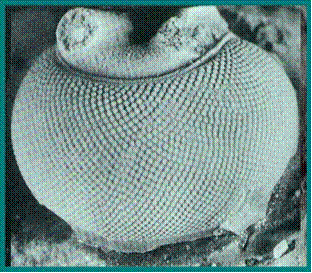
THE EYE OF THE TRILOBITE
A Miracle of Creation


http://shkrobius.googlepages.com/wondersofnature


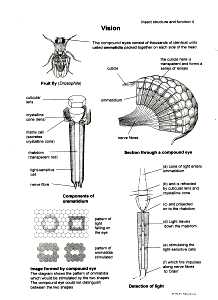
A beautiful drawing can be seen above. The link is here, where it can be viewed at a larger size: http://www.biology-resources.com/insects-02.html


Let’s first get acquainted with a compound eye. Instead of the single eye such as we have, each compound eye consists of a thousand or so individual ‘eyes’ called ommatidia.

Each ommatidium is made up of a lens (more about this later), a crystalline cone under it, and a nerve cell which conducts the electrical impulse to the creature’s brain where it is interpreted.

Around each cone (corresponding to the biscuit of an ice cream cone) is a layer of light absorbing material, which prevents the light in each cone being scattered and degrading the image created by other ommatidia.

All arthropods have this type of eye.

The trilobite’s eye, consisting of millions of honeycomb-shaped tiny particles and a double-lens system, this eye "has an optimal design which would require a well-trained and imaginative optical engineer to develop today". David Raup

”Moreover, the honeycomb eye structure of the trilobite has survived to our own day without a single change. Some insects such as bees and dragon flies have the same eye structure as did the trilobite.”

So, to put it plainly, the design of the trilobite’s eye was so advanced that it exists today, virtually unchanged. That unchanging structure is direct testimony that evolution has not taken place: certainly not in this structure.

I used the word ‘design’ because it clearly meets the criteria for deciding whether or not something was designed: it is a complex structure, it has a specific function, and it employs advanced information in its construction. To reiterate:

1 It is a very complex structure, not a simple one that may have just happened.

2 It has a specific function, which it fulfils well – and we know that because the eye has persisted unchanged for millions of years.

3 It makes use of information – which blind mutations cannot do. The high quality of the information is shown below.

The lens system refracted light incident from any angle into the trilobite vision system. A small wall to keep refracted light from interfering also partitioned the separate lenses. This is a feature of modern cameras: there is a light absorbing layer (usually black) inside the camera’s film chamber – to absorb stray light and prevent it degrading the image.

This is clear evidence of specificity of the design. The Designer knew about light scattering, and specifically prevented it. He knew about lenses, their required curvature, and the aberrations that such lenses produced. And as a direct, required consequence, produced the next invention:

‘The thick lenses in the aggregate eyes of a group of trilobites were doublet structures designed to eliminate spherical aberration.’ http://www.nature.com/nature/journal/v254/n5502/abs/254663a0.html
Nature 254, 663 - 667 (24 April 1975); doi:10.1038/254663a0

“The thick lenses in the aggregate eyes of a group of trilobites were doublet structures designed to eliminate spherical aberration. The shape of the optically correcting interface is in accord with constructions by Des Cartes and Huygens and is dictated by a fundamental law of physics. Trilobites may have evolved such sophisticated eye-lenses to maximise optic neurone response in a dimly lit environment.”

This is even clearer use of information, proving conclusively that design is present. The Designer knew about correcting spherical aberration by using doublets possessing different refractive indices. He was way ahead of DesCartes and Huygens, and knew about the fundamental law of physics governing such correction.

He also knew about amplifying dim light – presumably as Night Vision Goggles are intended to do today, as the authors above said: “…such sophisticated eye-lenses to maximise optic neurone response in a dimly lit environment.”


Here is another article describing the same phenomenon.

“This eye possessed an internal optical-doublet structure together with a refracting interface (comprised of two lenses with differing refraction so they would work together) that corrected focusing - a lens design that human scientists would repeat hundreds of millions of years later.” (In fact courses on optical DESIGN are offered which teach about optical doublets, inter alia). Here if you want to attend one: http://www.imperial.ac.uk/research/optics/msc/syllabus.htm

In case you don’t know, spherical aberration is the blurring of an image that occurs when light from the margin of a lens or mirror with a spherical surface comes to a shorter focus than light from the central portion. The changing focal length is caused by deviations in the lens or mirror surface from a true sphere.

‘The novel eyes of the trilobites were a particularly effective adaptation to underwater sight, and were ostensibly plagued by neither near-sightedness nor far-sightedness. Close and distant food and predators would be simultaneously in focus.

This is a feature of modern wide-angle lenses: which are among the most advanced in the world. And here it is in the eye of a humble trilobite, millions of years ago.

Evolution is helpless to produce such a structure. A Designer, on the other hand, could do it with ease.

THE CAMBRIAN EXPLOSION UNDER EVOLUTION

THE CAMBRIAN EXPLOSION

Having read a great deal about this ‘explosion’ I want to put before the expanding readership some little facts that they may not know. These facts show that it is far beyond the bounds of credibility for so many, and such varied organisms to have evolved in any step by step fashion.

Simply because they appeared so suddenly and in one fell swoop.

This obviously bothered Darwin, and later on, Gould and many other palaeontologists. There is NO credible evolutionary explanation of the phenomenon, and I am amazed to know that so many informed people (on the subject of the Cambrian explosion, I mean) can look at those facts in the face, and still go along with the ToE.

What does ‘Cambrian’ mean?

Palaeontologists dig down into the earth’s crust, and they have found that there are many layers of rock. They’ve given the layers some very long and fancy names, and the names depend on the kind of fossils in the rock.

The oldest animals/ plants are in the deepest layers, which are the oldest ones, and the newest animals/plants are in the highest ones.

Right at the very bottom of the layers is granite, which cannot and does not contain fossils, and is the oldest of the rocks.

So imagine a pack of cards resting on a granite surface. The granite represents the basement layer of rocks and piled on top of it are the cards, each of which represents a layer of rock. The layer resting on the granite is called the ‘Pre-Cambrian’ layer, and contains a very limited number of fossils: limited both in number and kind.

The layer on top of that one is the ‘Cambrian’ layer, and it is this one we are going to discuss in brief.

What’s in the Cambrian Layer?

To everybody’s astonishment, especially the people who believed in the gradual evolution theory, there are thousands upon thousands of different kinds of animals and plants in that layer, and they weren’t simple ones either.

Here are some famous evolutionists:

Most families, orders, classes, and phyla appear rather suddenly in the fossil record, often without anatomically intermediate forms smoothly interlinking evolutionarily derived descendant taxa with their presumed ancestors.
• Eldredge, N., 1989
Macro-Evolutionary Dynamics: Species, Niches, and Adaptive Peaks
McGraw-Hill Publishing Company, New York, p. 22


The record jumps, and all the evidence shows that the record is real: the gaps we see reflect real events in life's history -- not the artifact of a poor fossil record.
• Eldredge, N. and Tattersall, I. (1982)
The Myths of Human Evolution
Columbia University Press, p. 59


Described recently as "the most important evolutionary event during the entire history of the Metazoa," the Cambrian explosion established virtually all the major animal body forms -- Bauplane or phyla -- that would exist thereafter, including many that were 'weeded out' and became extinct. Compared with the 30 or so extant phyla, some people estimate that the Cambrian explosion may have generated as many as 100. The evolutionary innovation of the Precambrian/Cambrian boundary had clearly been extremely broad: "unprecedented and unsurpassed," as James Valentine of the University of California, Santa Barbara, recently put it (Lewin, 1988).

"This is true of all thirty-two orders of mammals...The earliest and most primitive known members of every order already have the basic ordinal characters, and in no case is an approximately continuous sequence from one order to another known. In most cases the break is so sharp and the gap so large that the origin of the order is speculative and much disputed...

This regular absence of transitional forms is not confined to mammals, but is an almost universal phenomenon, as has long been noted by paleontologists. It is true of almost all classes of animals, both vertebrate and invertebrate...it is true of the classes, and of the major animal phyla, and it is apparently also true of analogous categories of plants.
• Simpson, G. G. (1944)
Tempo and Mode in Evolution
Columbia University Press, New York, p. 105, 107


The gaps in the fossil record are real, however. The absence of a record of any important branching is quite phenomenal. Species are usually static, or nearly so, for long periods, species seldom and genera never show evolution into new species or genera but replacement of one by another, and change is more or less abrupt.
• Wesson, R., 1991
Beyond Natural Selection
MIT Press, Cambridge, MA, p. 45


We could go on collecting these quotes. But I want to underline 2 important things.

1 Darwin was wrong, is wrong, and will continue to remain wrong in THIS MOST IMPORTANT MATTER. The fossils say so. There’s nothing gradual about all this – it was BANNNGGGG!!!! Here we all are.

2 All these diverse forms performed ALL THE FUNCTIONS OF ALL LIVING THINGS.

Therefore they all had the instincts required to perform all these functions.


As we've seen, eating (as an example in the first post on this blog), is powered by instinct.

The animal has to know what is food, what to do with it; how to catch it; where its mouth was; what to do with whatever it used to catch its food. All these are basic instincts. The food had to be processed and absorbed - and it is a form of instinct that does all this.

All these HAD TO BE PRESENT IN THEIR ENTIRETY, or the first such animal would immediately have perished.

Therefore, the Cambrian layer represents not only a vast explosion of physical types, it also represents a vast explosion of instinct implantation.

An evolutionist can, and will argue till the cows come home, about intermediate fossils, the incompleteness of fossilization in the preCambrian etc etc. But if he has a single leg to stand on, it is yanked violently from under him by the fact that he HAS to account for the ORIGIN,and implanting of all of these instincts IN THEIR ENTIRETY in about a billion organisms, at more or less the same time.

I was interested read that Gould was of the opinion that the Cambrian period lasted no more than 5 – 30 million years, but the likelihood is that the figure of 5 million was most likely to be the truth.

So all this incredible diversity arose in a geological eye-blink – which is exactly what the creation model predicts.

No evolution here!

See also:
http://www.wasdarwinright.com/intermediates-f.htm


NEW! HOT OFF THE PRESS!!


“HOW DOES INSTINCT EVOLVE”

OR

Evolution's Soft Underbelly
by Asyncritus


AT LAST!

The Argument Darwin Dreaded…
The Argument No-One Has Developed Before…
The Argument to Which There Is

NO ANSWER FROM THE EVOLUTIONISTS!


35,000 viewers of my articles can’t all be wrong. Check Google for this subject and see!
http://www.thenakedscientists.com/forum/index.php?board=17.30

100 pages of amazing facts and carefully reasoned arguments. Equip yourself! Give your children the knowledge to defend belief in Creation in class!

Get your copy here. Only $19.97 as pdf.
$27 plus $5 p&p in CDR format.


CDR Version


Published by phillauren.org

MEIOSIS:THE WONDERFUL DIVISION

NEWS FLASH!


NEW! HOT OFF THE PRESS!!


“HOW DOES INSTINCT EVOLVE”

OR

Evolution's Soft Underbelly
by Asyncritus


AT LAST!

The Argument Darwin Dreaded…
The Argument No-One Has Developed Before…
The Argument to Which There Is

NO ANSWER FROM THE EVOLUTIONISTS!


35,000 viewers of my articles can’t all be wrong. Check Google for this subject and see!
http://www.thenakedscientists.com/forum/index.php?board=17.30

100 pages of amazing facts and carefully reasoned arguments. Equip yourself! Give your children the knowledge to defend belief in Creation in class!

Get your copy here. Only $19.97 as pdf.
$27 plus $5 p&p in CDR format.


CDR Version


Published by phillauren.org

MEIOSIS

If the process of mitosis was amazing, and shows that design is necessary to produce two new cells containing exactly the same number of chromosomes, then what must we say about meiosis?

Meiosis produces the sex cells.

The process of division in this case, however, doesn’t produce exactly the same number of chromosomes in the daughter cells, but EXACTLY HALF that number.

So if there are 10 chromosomes in the parent cell, the process of meiosis produces 5 in each sex cell.

Whereas mitosis takes A.A B.B C.C D.D E.E

And produces A.A B.B C.C D.D E.E and another set of A.A B.B C.C D.D E.E ,

meiosis takes A.A B.B C.C D.D E.E and produces A B C D E and A B C D E.

The pure astonishment that this creates in the mind of the onlooker is enormous.

As I said before, if in the same organism we have cells with 10 11 12 13 14 etc chromosomes, nothing short of chaos would result.

But here, in the sex cells, we have 5 chromosomes in each new cell, and no chaos results.

That, however isn’t the really astonishing part. The question arises, why does this happen? And the answer is extremely simple.

To produce a new organism with the original 10 chromosomes in each body cell, each parent must contribute exactly half the number ie 5. So the 10 is made up of 5 from one, and 5 from the other. And that is exactly what happens, because of this process of meiosis.

The mechanism of meiosis is in outline broadly similar to mitosis, but the details are quite different, and too technical to include here. There are some nice pictures here:


Source: http://publications.nigms.nih.gov/thenewgenetics/images/ch1_meiosis.jpg

I simply want to make the point that there is purpose, design, counting, and most remarkable of all, foreknowledge in the design of what happens.

Consider:

Somebody knew how to count.

Somebody knew that if 10 chromosomes from A combined with 10 chromosomes from B, there would be 20 in the offspring, which would create chaos.

Somebody therefore decided that the 10 had to be halved, and the halving had to be done properly, so A.A B.B C.C D.D E.E would produce A B C D E and A B C D E , not A A B C D or something else that wouldn’t work.

Somebody knew that in the reproductive process, 1 cell from A would join up with another cell from B.

Somebody, somehow, planted in the chromosomes of every body cell, the DNA programming which would eventually make sure, that even if every other kind of cell would reproduce by mitosis, the sex cells wouldn’t.

Somebody designed the second process (meiosis), not as an afterthought, but having made the decision that that was the way to go. And what an ingenious way it is, too.

Somebody made sure that all the necessary mechanisms needed to ensure that sperm from A would reach the ovum from B – and just how long and complex a story that is, many textbooks on sexual reproduction demonstrate very clearly.

All of which argues purpose, intelligence, design, very deep knowledge of the outcome, and of the biochemical processes that would be needed to produce the desired outcome.

Purpose requires intelligence and knowledge.

The mechanism’s design also demonstrates intelligence and fearsome knowledge.

Therefore, chance is eliminated. No accumulations of random mutations could possibly produce this mechanism, because all this had to exist before mutations could occur!

God did it.

MITOSIS, MEIOSIS and PURPOSE

MITOSIS, MEIOSIS AND PURPOSE

Mitosis

For those who may not know, a cell can divide in two ways. It can use a process called mitosis, or it can use the other method called meiosis.

The mechanics of the two processes are quite startling, and are very clearly designed to carry out their absolutely vital functions accurately.

Cells have to reproduce themselves in order for growth to take place, to repair damage, for simple maintenance and other needed functions.

When they divide, the number of chromosomes, and thus the genes on them must be replicated exactly in the new cells, otherwise damage and destruction will take place. A mutation damages the genetic make up of the cell, and such damage is destructive in 99.99% of the cases in which it occurs.

Which is only to be expected. If the plans for say, a car, become damaged in any way, and the construction continues despite the damage, we wouldn’t be too surprised to find the steering wheel up the exhaust pipe, or the engine in the passenger seat! Either way, the car will not function, or at best will be badly impaired.

Continued damage to the plans, does not, or is most unlikely to produce improvement in the car. No matter how many times we tear up and reconstitute the plans for a Honda Civic, we will never get the plans for a Boeing 747.

And there is another problem, the problem of size. A Rolls Royce is not simply a scaled up version of a Honda Civic. It is a completely different animal, whose physics, chemistry and metallurgy are entirely changed. The design of a mud hut cannot simply be enlarged to produce the Empire State Building. It would definitely look a bit odd, for starters.

In the cell, the damage can be of several well known kinds.

1 The chromosome may duplicate itself unnecessarily: so there is one or more than one extra chromosome in the make up.

2 The chromosome may have a section torn off or lost

3 The chromosome may break and rejoin the wrong way round, so instead of the genes being in the order AAABBBCCC, something else appears like CCCAAABBB. This also produces damage, much as if a page of the plans for the car was torn in 3, and the sections glued back in the wrong order.

In every case there is damage of one sort or another. Mutations occur frequently, but beneficial mutations are extremely rare, and never produce new species, far less new genera. Micro-evolution, like the emergence of bacteria resistant to antibiotics, is a very long way indeed from the macro-evolution of a whole new family, or phylum.

But back to mitosis.

In a normal body cell, let’s say there are 10 individual chromosomes. These are in pairs, so there are 5 pairs. In order to make sure that the daughter cells have exactly the same number of chromosomes, this remarkable process takes place.

A.A B.B C.C D.D E.E

Each pair of chromosomes copies itself exactly.

A.A B.B C.C D.D E.E ---> A.A A.A B.B B.B C.C C.C D.D D.D E.E E.E

So for a brief moment, the cell has 20 chromosomes, in 10 pairs. 5 pairs are exact replicas of the other five. The dot in the middle indicates that they are joined at a certain point.

Two structures called centrioles appear, and move to the opposite ends of the cell, and fibres begin to appear: they then join, believe it or not, to form what is called a ‘spindle’. The nuclear membrane disappears.

Amazingly, the chromosomes arrange themselves at the ‘equator’ of the spindle and are attached to the fibres of the spindle.

The spindle pulls them apart, and they separate, going to the opposite ends of the cell. So at each end of the cell there are now 5 pairs of chromosomes. The original number.

The nuclear membrane reforms round the chromosomes, and the cell pinches in the middle, and two new cells are now formed, each containing 5 pairs of chromosomes: A.A B.B C.C D.D E.E once more.

Here are still photographs of the process by Anne Bruce: http://www.microscopy-uk.org.uk/mag/indexmag.html?http://www.microscopy-uk.org.uk/mag/artaug99/mitosis2.html

And here is an animation: http://www.cellsalive.com/mitosis.htm >

There is very clear purpose in every move of this division process.

1 The chromosomes duplicate themselves, as if they knew that the new cell must have a copy.

2 The spindle is constructed, at the right time and in the right place SO THAT it can pull the chromosomes apart from their joint. It is a subject of much research, which is showing much protein involvement in the structure.

3 The nuclear membrane dissolves, with the purpose of getting out of the way so the division can take place.

4 The chromosomes arrange themselves at the ‘equator’ of the spindle, the maximum distance away from the centrioles SO THAT the maximum leverage can be exerted on them to separate them. They separate.

5 They move to opposite ends of the cell, SO THAT each new cell has exactly the same number of chromosomes as the original.

6 But number is not enough. Five DIFFERENT chromosome pairs must be in each daughter cell. This way of doing the division ENSURES that they ARE different.

7 The nuclear membrane reforms when the division is complete, and TO COMPLETE THE PROCESS, the cell wall itself pinches off to make 2 new cells.

At every step of the way, design, foreknowledge and purpose are displayed. The most surprising thing in my view, is that the exact numbers of chromosomes is preserved in each daughter cell. If they weren’t, then chaos would soon result.

Order, purpose, design, and intelligence are displayed in abundance in this process. There is nothing whatsoever left to chance. If it were, there would be, as I have said, chaos in the genetics of the organism, which would result in death, disease or sterility.

The probability of the biochemistry of this process having emerged by chance movement of molecules is ridiculous. The very possibility does not exist. Errors here, and even more so in meiosis, would result in the extinction of life itself.

But we here run up against the old, old evolutionary conundrum. Life could not exist without mitosis, and mitosis could not exist without life. Therefore, life and mitosis could not have come from inert molecules.

God designed them.


NEW BOOK! HOT OFF THE PRESS!!


“HOW DOES INSTINCT EVOLVE”

OR

Evolution's Soft Underbelly
by Asyncritus


AT LAST!

The Argument Darwin Dreaded…
The Argument No-One Has Developed Before…
The Argument to Which There Is

NO ANSWER FROM THE EVOLUTIONISTS!


35,000 viewers of my articles can’t all be wrong. Check Google for this subject and see!
http://www.thenakedscientists.com/forum/index.php?board=17.30

100 pages of amazing facts and carefully reasoned arguments. Equip yourself! Give your children the knowledge to defend belief in Creation in class!

Get your copy here. Only $19.97 as pdf.
$27 plus $5 p&p in CDR format.


CDR Version


Published by phillauren.org